
June 2026 Newsletter
Decoded: AI News for Alternative Assets
The race that matters
Within a few weeks, three of the most watched private companies in the world all announced they’re headed for the public markets. It is a pointed reminder of how far we have come, and a fun distraction from the quarter’s more practical story. The same labs chasing trillion-dollar debuts spent the quarter packaging their models by industry and building firms to deploy them, because the hard part now is fitting the technology to real workflows. That deployment race is what has the potential to reshape your operations.
Here’s what we at Aithon found interesting this quarter:
- The frontier labs are shipping industry-specific AI now
- Solving the unglamorous “coordination work” of the fund operations
- The second leg of the AI race now focuses on implementation
- Traceability is finally getting the recognition is deserves
- The same AI that sharpens your operating model can be used against it
- Private markets CTOs are treating AI as a competitive moat

The labs go vertical
The News
In nine days in May, Anthropic shipped three industry-specific AI bundles: one for financial services (ten ready-to-run agents plus connectors to FactSet, PitchBook, and others), one for legal, and one for small business. Each bundle includes pre-built agents, data connectors and domain instructions for its target industry.
The Translation
The financial services bundle is the one pointed at our space. Its ten agents target a broad range of functions: a pitchbook builder that assembles comparables and drafts the deck, a KYC screener, a “month-end closer”, a statement auditor, an earnings reviewer, and a reconciliation agent that (supposedly) maps straight into fund accounting.
The legal bundle wires their model into the law firm stack (Westlaw, LexisNexis, iManage). The small business bundle connects to QuickBooks, Stripe and HubSpot to chase invoices, reconcile payments and keep the books current. Broad coverage would be an understatement.
The So What?
Here's the question I ask myself – how many verticals can one company truly know? The small business bundle only works because someone who lives in those workflows built them. Ask whether anyone on your ops team could design a small business tax agent well enough to run it unattended. The answer, 99 out of 100 times, will be no, and the reverse holds just as true. A team that has mastered small business bookkeeping has never seen a management fee offset or a carried-interest catch-up.
So if, or more realistically when, an "AI for alternatives operations" bundle finally arrives, the smart instinct is to ask what it would miss. For a private equity manager, would it know that a side letter MFN clause cascades across the whole LP base? For a credit fund, would it understand how a PIK toggle reshapes an interest accrual? For a hedge fund, would it handle a master-feeder expense allocation? For a venture shop, would it carry the nuance of a SAFE converting across several rounds?
Taking off my skeptic hat, this is pretty cool. Look at the finance connectors and picture that same agent layer wired into your GL, your OMS and your reconciliation platform, reasoning across all three at once. That is the real prize. The firm that builds it will need to understand the domain as fluently as it understands the model underneath. That domain intelligence is quickly become a rarer commodity compared to model intelligence.
The $100 billion glue between your systems
The News
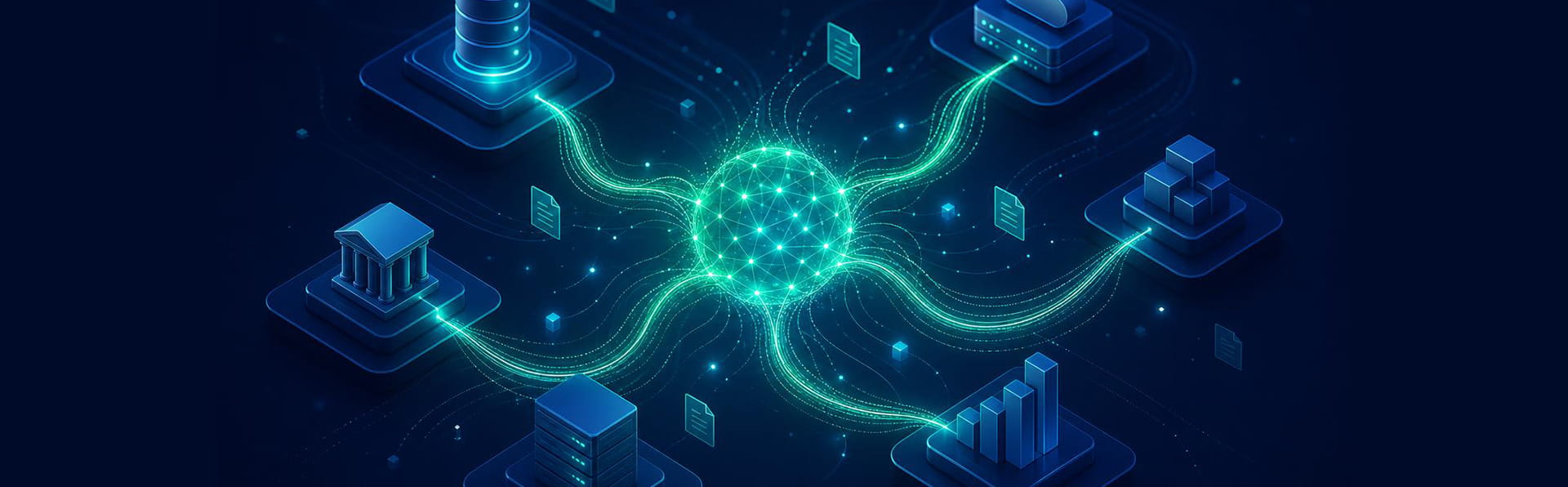
Bain & Company estimates that "coordination work," the human labor of moving data between systems that don't talk to each other, is a $100 billion US market that traditional automation can't touch but agentic AI can. More than 90% of it is untapped.
The Translation
Bain's core claim is a striking one: the biggest near-term software market is the human glue between systems of record. They call it coordination work which is essentially the labor of pulling a figure out of one platform, checking it against another, interpreting that difference and deciding what to do next. Rules-based automation and RPA struggle here because the work runs on judgment and ambiguity rather than clean, predictable handoffs. Agentic AI changes that equation since it can read across disconnected sources, reason about what it finds, and act inside defined guardrails.
The So What?
Anyone who’s ever managed the middle and back-office knows this coordination work intimately, because it is most of what we do in terms of time. It is digging a fee provision out of a side letter in a document system, then applying that carve-out to a capital call allocation in a different platform entirely. It is the expense cycle that lives in four places at once: an invoice arrives in someone's inbox, the allocation gets run in one system, the accrual gets booked in another, and the payment goes out from a third. None of these systems were built to talk to each other, so a person stitches them together by hand, adding bits of reasoning along the way.
This is where agentic AI shines. An agent can do the assembly: gather the invoice, pull the allocation basis, line up the supporting documents, apply the rule set, and hand a person a reasoned recommendation with backup attached. That "assemble and reason, then expert decides" pattern fits a surprising amount of fund operations, from an onboarding file to an expense allocation to a NAV close.
The opportunity is real but the question is who delivers it to you, and how soon. One path is to wait for your core platform provider to build it (you be the judge of how long that takes). Unfortunately once they do, there is little reason to expect one provider's AI to coordinate cleanly with another's, which leaves the same gaps between platforms that created the problem in the first place. The other path is an overlay: a lighter AI layer that sits across the systems of record you already run and handles the coordination between them, without ripping anything out. We may be a little biased on which approach we prefer, but the logic is hard to argue with. Coordination work is where time and errors quietly accumulate, and the moment to go after it is now.
Quick Hits
What You Need to Know
Our Take: The models are ready but the bottleneck is the scarce talent who can build them into a live operation. This is a step in the right direction but comes with one caveat – a general-purpose deployment engineer can wire up the plumbing, but they will not know why your operational workflows run the way they do. The firms that pull ahead will be the ones that bring both sides to the table at once: people fluent in AI, and people who have actually run the process being automated.
A strong starting point, not a finished one
What Happened: A new benchmark powered by 500+ investment bankers tested top AI models on 100 real banking tasks. 41% needed major rework, 27% were unusable, and none were rated client-ready as they stood.
Our Take: Before you read that as a failure, notice that more than half the bankers said they would happily use the output as a starting point. The benchmark also showed scores climbing sharply once prompts carried the context an experienced banker takes for granted. Domain knowledge is what turns a weak draft into a reliable one, and it stays the hardest thing for a generic tool to replicate.
AI on top of the system of record
What Happened: FIS partnered with Anthropic on a financial crimes agent where AI assembles the AML evidence and drafts the suspicious activity report, and an expert makes the final decision.
Our Take: The AML use case is interesting but I encourage you to take this as inspiration for other parts of your operating model. An AI layer sits on top of a system of record, prepares the data, applies the rules, and supports a human's reasoning, all without the data ever leaving the controlled environment. That same framework applies right across the fund lifecycle, from onboarding to investor reporting. Food for thought.
Show your sources
What Happened: Perplexity launched Computer for Professional Finance, a research platform where every data point links back to its primary source, with inline citations in a consistent format.
Our Take: Professional investment work lives and dies on traceability. Combine that fact with the knowledge that AI is never 100% accurate, and you’ll land at the conclusion that provenance is a 100% mandatory requirement for any modern-day solution. "Trust me" has never been an audit trail.
Our Take: The same advances that let you rebuild an operating model also arm the people trying to break into it. An autonomous agent can now map, probe and exploit a weakness at breakneck speed with no human steering it. Ask your AI and data vendors how often they run automated security testing, since an annual penetration test only catches last year's problems. And treat the prompts and documents feeding your AI with the same care as production code, because a quietly poisoned instruction can corrupt every output downstream without leaving a trace.
The Numbers That Matter
10 hours
Median time from a public CVE (Common Vulnerabilities and Exposures) disclosure to a working exploit in the wild, down from 56 days in 2024.
Your IT vendor's monthly patch cycle no longer counts as a defensible posture for anything facing the internet.
Jargon Decoder
Demystifying AI Terms
Headless Agent
An AI agent that runs in the background through an API with no chat window attached, doing its job inside other software rather than waiting for someone to type at it. Most production fund-ops automation will look like this, not like a chatbot.
LLM-as-a-Judge
Using one AI model to grade the output of another at scale, because no human team can review thousands of answers by hand. Fast and cheap, but worth remembering the grader has its own blind spots.
The Gut Check
This Month’s Question
About Aithon
Aithon Solutions delivers intelligent automation and data solutions purpose-built for investment management operations. Our proprietary technology seamlessly integrates with existing systems to enhance operational efficiency, improve reporting accuracy, and unlock deeper business insights. By combining domain expertise with applied AI, we help asset managers do more with less—adding new products and clients faster while driving better outcomes through reimagined processes.